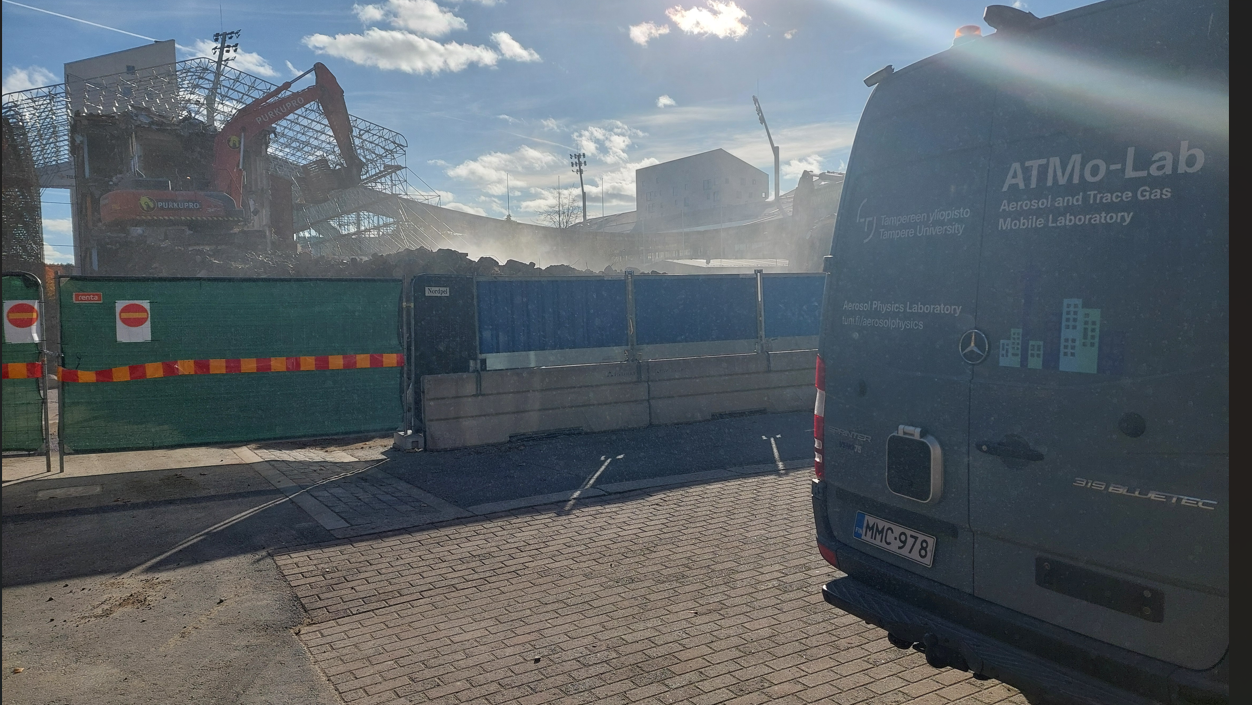
The impact of the Tammela school demolition site on air quality was investigated at the request of the City of Tampere through measurements taken between 16 and 28 September. According to the results, the demolition of the school impaired air quality in the immediate vicinity of the site. Measurements taken on the Väinölänkatu side in September showed that dust concentrations were significantly elevated. However, there was no significant exposure to asbestos or quartz outside the site.
Measurements were taken at two locations, on Väinölänkatu and Ilmarinkatu, approximately 100 metres away from the temporary school building used by the pupils. The distance from the measurement points to the demolition site was approximately 20–30 metres. Wind conditions were a key factor in the selection of the measurement locations.
Concentrations decreased as the distance from the site increased. However, interpreting the measurements taken further away was complicated by turbulent wind conditions caused by the surrounding buildings, which often caused the dust cloud to drift past the measurement point.
The measurements were carried out using a mobile laboratory equipped with measuring instruments and sample collectors. Tampereen tilapalvelut Oy commissioned the measurements from the University of Tampere.
No clear benefit from the use of a water cannon
During the demolition of Tammela school, a water cannon was used for the majority of the time to suppress dust. However, short-term fluctuations in dust concentrations were primarily influenced by the work stages underway at any given time and by local wind conditions.
The building being demolished was quite tall, and the water cannon’s spray did not reach as far as the roof. Measurements showed that the use of the water cannon did not clearly reduce concentrations of respirable particles or fine particles.
Generally, the aim is to prevent the spread of dust and other emissions at construction sites located near, for example, schools or nurseries. It has been found that watering access routes and piles of crushed stone at construction sites reduces dust formation.