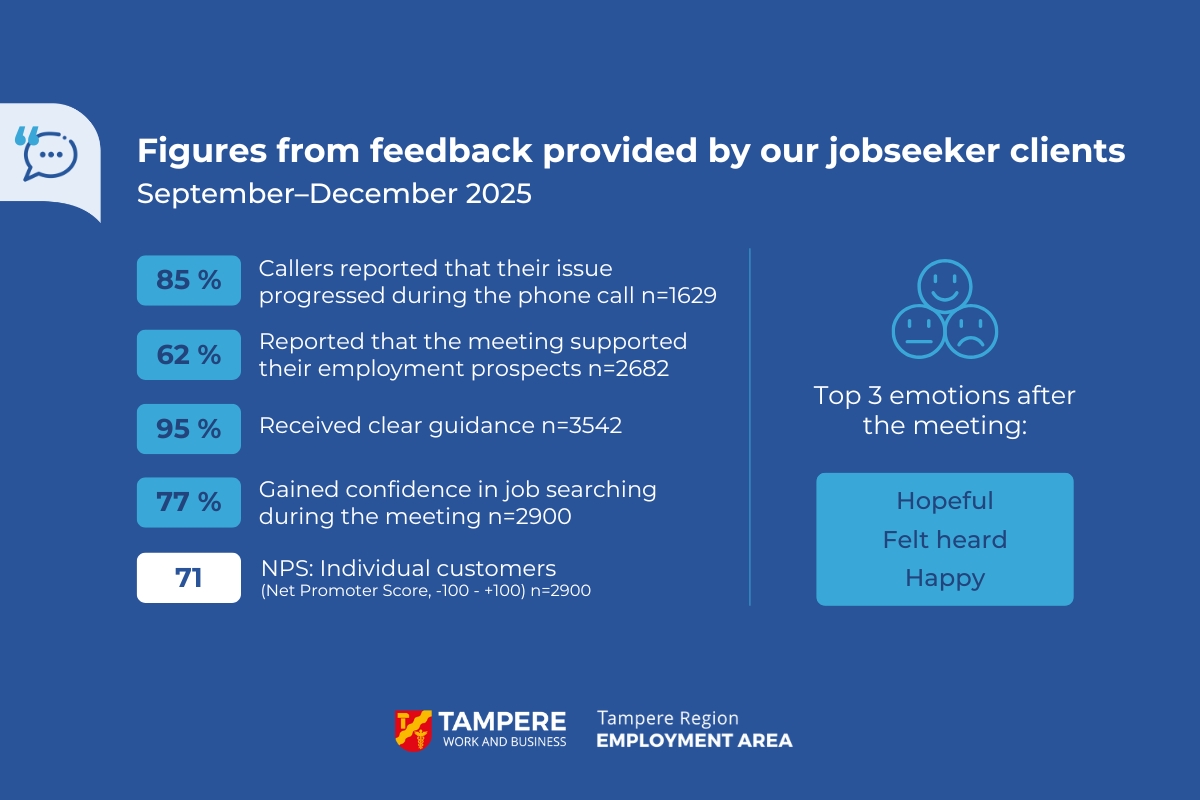
The Tampere Region Employment Area collects feedback from job seekers systematically at different stages of the service path – from telephone counselling to job search discussions. The feedback is used to improve services, with the aim of developing even more customer‑oriented and streamlined service experience. Emotions are also measured: how the interaction felt and what kind of impression it left.
The phone counselling receives recognition
During autumn 2025, more than 1,600 feedback responses were received on phone counselling. Eighty‑five percent of respondents felt their matter was resolved during a single call. The service is described as friendly, professional and approachable. Many report feeling respected, and quick response times as well as clear answers are frequently praised.
Job search discussions increase confidence and hope
The job search and supplementary discussions are statutory parts of the service process. Their purpose is to support job seekers’ employment and to provide clear, understandable and encouraging guidance. In autumn 2025, nearly 3,000 feedback responses were received regarding these discussions. The overall feedback is clearly positive.
The majority of respondents found the meetings useful: 95% received clear instructions, 77% reported increased confidence in their job search, and 62% felt the discussion had supported their employment prospects. Customers describe the discussions as attentive, realistic and tailored to their individual situation.
Clear instructions, concrete advice and the opportunity to have open discussion about own situation were particularly appreciated. Many reported that the discussions provided hope and direction, even though the labour market situation is challenging. Phone and remote appointments were considered convenient and helpful in easing daily life for many.
Customer experience is also assessed through emotions. In autumn 2025, one third of respondents felt acknowledged, and one quarter reported feeling hopeful. One in five felt happy. Among negative emotions, the most common – frustration – was reported by only 3% of respondents.
– The customer feedback shows above all that our personnel has done exceptionally good work. Even though we have been operating in the middle of a major transition and a difficult labour market situation, the quality of customer meetings and discussions, the clarity of our guidance and support of our customers in employment have remained strong – and this is directly reflected in job seekers’ experiences,” says Director of Employment and Growth Regina Saari.
Feedback guides service development
The feedback also highlights areas where the smoothness of the service should be improved. Some job seekers feel that the meetings can become routine-like if no concrete solutions are found or if the job search does not progress as hoped. Obligations are sometimes perceived as time-consuming without providing real benefit. Individual comments also point to challenges related to the functionality of digital services, the rigidity of systems and the desire to handle matters remotely rather than through in‑person appointments.
Feedback from phone counselling reflects similar expectations for smoother service. In busy situations, rescheduling or cancelling an appointment can at times be perceived as inconvenient. Some respondents noted that reaching their Customer Specialist can be difficult. Development needs are especially visible in cases where issues cannot be resolved in a single contact or when the service requires several steps. Based on the feedback received, internal practices have been updated to ensure that matters can be resolved more smoothly and in fewer steps whenever possible.
Customer feedback is reviewed regularly at all organisational levels within employment services and with the aim it leads to concrete improvements. Customers are also informed about how their feedback has influenced service development.
– Feedback helps us identify the areas where the smoothness of services still needs to be improved. Collecting and reviewing feedback is a key tool for us in developing operations and ensuring that the customer experience continues to improve. Some of the development needs relate to national structures, such as systems and bureaucracy. We are working closely with the KEHA Centre to find solutions so that we can also influence service efficiency at the national level and thereby improve customers’ day‑to‑day experience, says Director of Employment and Growth Regina Saari.