
Laikku's new exhibitions explore the interfaces between the digital and physical worlds and the diversity of linguistic and cultural identities
The first exhibitions of 2026 at Culture House Laikku invite reflection on visual expression and identity. In Jouni Toni’s works, geometric forms, pastel tones, and striking contrasts create spaces where lightness meets emotional depth. Zeynep Kaynar explores how minority identities are constructed and represented in urban environments. Both exhibitions open on Saturday, January 10, 2026.
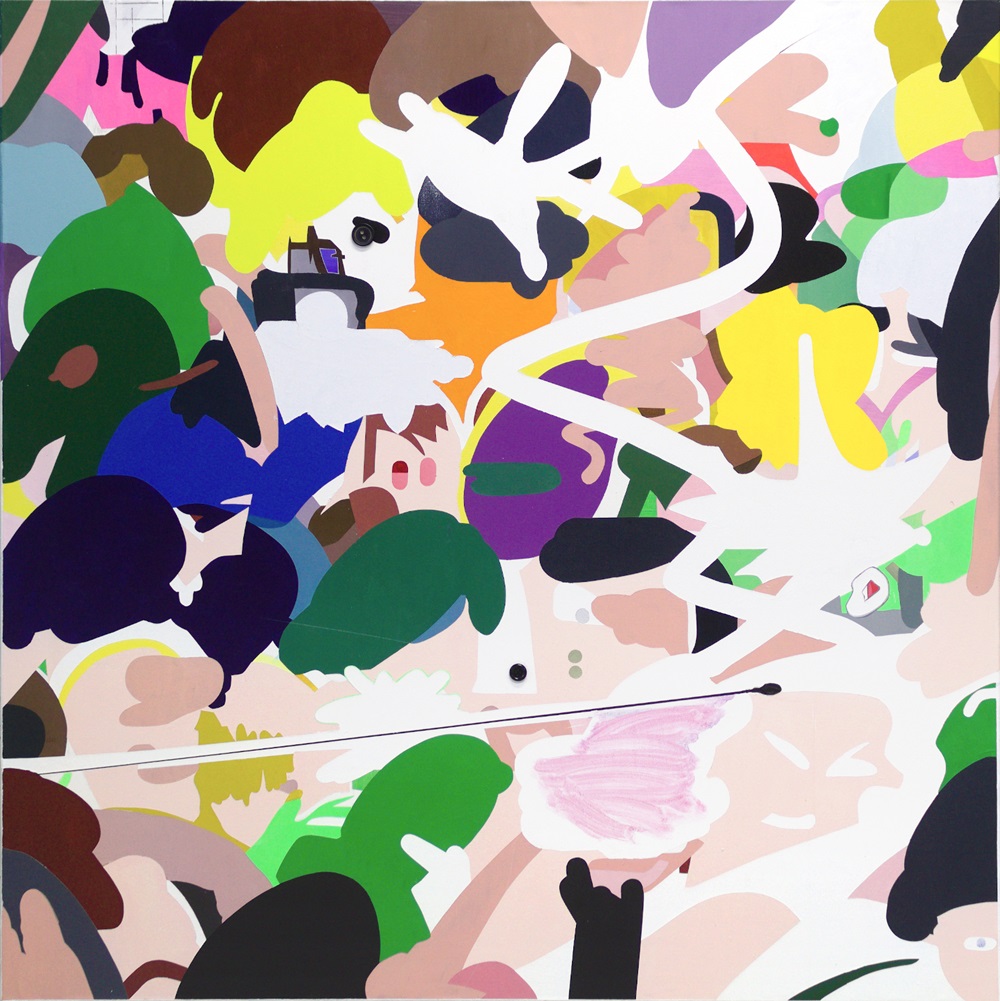
Jouni Toni: Trigger (2021)
Laikun Galleria's first exhibition of the year is Jouni Toni’s Cut. At the core of Jouni Toni’s practice lies a digital sketching process that has generated an archive of thousands of images. Digitality enables a freely flowing experimentation where compositions and colors transform endlessly before they move onto canvas.
“Cutting and incisions connect all the works in this exhibition and their creation process, regardless of the subject matter. For this body of work, the cutting has been completed, and the results are now on display," Toni tells about his artwork.
At the core of Jouni Toni’s practice lies a digital sketching process that has generated an archive of thousands of images. Digitality enables a freely flowing experimentation where compositions and colors transform endlessly before they move onto canvas.
The finished paintings are built in layers, reflecting a dialogue between the digital and the analog worlds. In Toni’s works, geometric shapes, pastel tones, and surprising contrasts create spaces where lightness meets emotional depth. This lightness, combined with recurring themes of emptiness and incompleteness, invites active viewers to complete the works on their own terms.
Ultimately, it is about an attempt to create order out of chaos – a need to distill the ever-accelerating flood of information and stimuli into perceivable wholes.
"From films we know that in Hollywood, the director’s job is to shout ‘Cut!’ In our daily lives, we are constantly exposed to wounds and slashes. Over time, the skin thickens, and the tools for healing sharpen. Art can serve as one of those tools among many. At the same time, cuts are being made… Well, let’s not get stuck overinterpreting the title, which I only came up with at the very last moment, after the works were already finished,” Toni explains.
Jouni Toni (b. 1984, lives and works in Tampere) graduated as a visual artist from Satakunta University of Applied Sciences in Kankaanpää in 2010. Toni worked as a resident artist at Rijksakademie van beeldende kunsten in Amsterdam, the Netherlands, in 2014–2015 and at WOW Amsterdam in 2017–2018. He has won first prizes both in the Royal Dutch Painting Competition in 2015 and in the Art of Basware competition for young artists in Finland in 2010. His works have been featured in numerous exhibitions in Finland and abroad, and in Finland, they are included in collections such as the Helsinki Art Museum.

At the same time, Laikku Studio will feature Zeynep Kaynar’s exhibition The SAPP – From Gesture to Form; Participant-Led Narratives in Contemporary Painting. The exhibition explores the multifaceted dimensions of identity and language within urban spaces. The works pose essential questions for the viewer: How are minority identities constructed and made visible in the urban environment? How does language function not only as a tool for communication but also as a cultural symbol and a visual marker?
"The themes of the exhibition are inspired by Maamme, a work that examines the heritage of Finnish culture and history. In light of its subject matter, I engage in dialogue with other painters, highlighting polyphony and diverse aesthetic perspectives on language, identity, and their representation in public space. This collegial and multi-perspective approach situates painting both within the continuum of cultural tradition and in contemporary discussions on diversity and belonging", Zeynep Kaynar shares.
Kaynar's research places painting at the center, examining today’s visual and textual culture as well as the multiplicity of linguistic and cultural identities. The works combine various techniques, such as acrylic painting and drawing tools, to create richness in textures and visual layers. The exhibition emphasizes painting’s ability to participate in social discourse and asks how visual language can reflect and challenge questions of belonging, diversity, and visibility in public urban space. Painting is positioned within a broader dialogue on identity and culture, reinforcing its value as both a personal and collective form of expression. The project underscores professionalism, polyphony, equality, collegial interaction, and the freedom and intrinsic value of art.
The exhibition invites audiences to consider how paintings can serve as platforms for conversation and dialogue, bringing forward the significance of minority groups as part of modern urban culture. For Kaynar, the exhibition marks an important step in professional development. It strengthens long-term resilience as a painter and a research-oriented approach that develops painting as both a tradition-respecting and experimental practice. The works draw on Kaynar’s evolving use of abstract forms and layered compositions, symbolizing contemporary visual culture and the diversity of linguistic and cultural identities.
The artist is committed to challenging the traditional solitary studio practice of painting in the long run, integrating socially oriented and participatory methods. In this way, painting can function as a platform for communal dialogue and artistic research, opening new perspectives on the interaction between contemporary art and society.
Zeynep Kaynar (born 1992 in Samsun, Turkey) studies semi-abstract and abstract visual language by adapting typographic design methods as observational tools in her fine art studio practice. She is an independent visual artist living and working in Finland. Kaynar has a list of selected exhibitions and publications, including upcoming solo exhibitions at Myymälä2 in Helsinki, Finland, and Simbart Projects in Istanbul, Turkey as well as previous group exhibitions in Istanbul, Madrid, Belgium and Copenhagen. Zeynep Kaynar holds a Master’s degree in Education focusing on topics of adult education, instruction design, and workplace pedagogy in organizational learning from Tampere University, which she completed in 2023, and a Master’s degree in Visual Arts and Visual Communication Design from where, she also spent time as a visiting graduate student in the University of California, Los Angeles, USA.
Laikku Gallery: Jouni Toni / The Cut
Laikku Studio: Zeynep Kaynar / The SAPP – From Gesture to Form; Participant-Led Narratives in Contemporary Painting
The exhibitions are on display January 10 – February 15, 2026.
Free admission.
Culture House Laikku
Keskustori 4, Tampere
Opening hours
Tue–Fri 9–20
Sat–Sun 10–18


