Death and memory meet in Culture House Laikku’s exhibitions – Teemu Mäki and Maria Ylikoski open new perspectives on life

On Saturday, November 1, 2025, Culture House Laikku opens two new exhibitions that explore life and memory from different perspectives. Teemu Mäki’s About Death invites visitors to reflect on mortality and the limits of life—not to depress, but to inspire. In the Studio, Maria Ylikoski’s Archive Silence reveals the personal histories carried by everyday objects and asks who remains visible and who is forgotten in official archives.
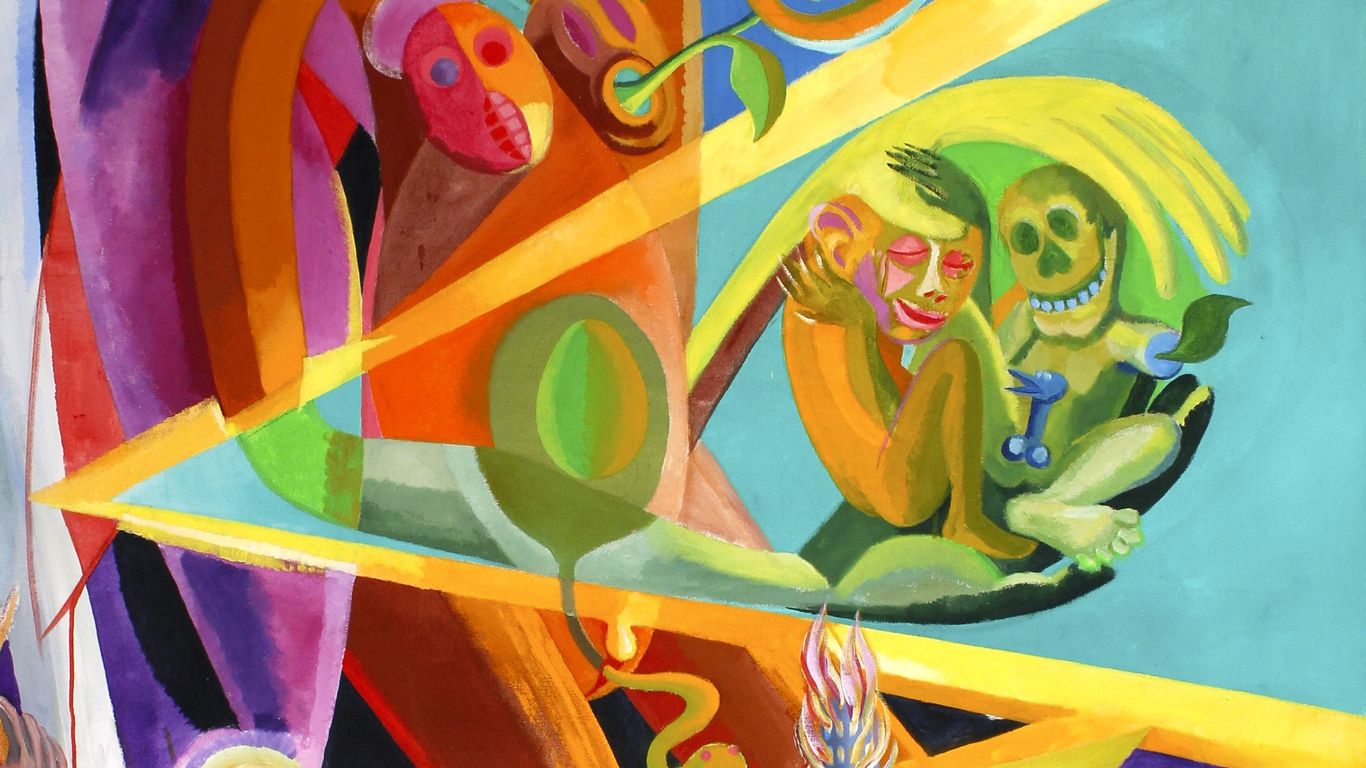
Värikkään maalauksen yksityiskohta.
Teemu Mäki, detail from the painting The God I Know.

Opening on November 1, 2025, at Cultural House Laikku, Teemu Mäki’s exhibition About Death explores mortality and life’s finiteness – not to sadden, but to inspire. The exhibition is part of the Tampere Parish Union’s Mortal project and offers a space to face death honestly through art.

The works in Teemu Mäki’s exhibition deal with death, but his aim is quite the opposite: to bring visitors joy and vitality. Mäki sees accepting death as a source of life’s meaning: finiteness makes life precious and awakens the ability to love. The exhibition invites us to consider how we can live a good life despite – or because of – our mortality.

The artist emphasizes that death cannot be addressed through reasoning alone; it requires practice and tools such as art. The exhibition provides a space to encounter death honestly and rediscover life’s joy. According to Mäki, compassion toward other living beings is also essential, especially in an era when humanity’s impact on nature is devastating.

Teemu Mäki’s exhibition About Death at Culture House Laikku includes paintings, drawings, photographs, and poems that examine different dimensions of death and mortality. Many works reflect on biodiversity loss, inequality, exploitation, and war – situations where death appears as a tool of human power. One example is the painting Grannies in the Middle of It All (Hey, Teachers of My Childhood, How Did It Come to This?).

The exhibition also features personal portraits of Mäki’s parents, such as I Remember Mother and the Raven and Pentti and Aatos, with the Grandfather Clock (In Memory of My Father). These works combine mourning with reflections on life stages – Mäki stresses that aging can bring sensitivity and new pleasures. The painting The God I Know merges two ideas: nature’s revenge on humanity and a fantasy of joyfully accepting mortality. Photographic works such as Suspension (Gravity) and Four Generations, Two Genders, One Death explore life’s cycle and generational continuity.

The poems delve into humanity’s relationship with God, other people, other species, and the omnipresence of death wherever life exists.

Teemu Mäki is a well-known artist, atheist, and socialist who also describes himself as a “Jesus fan” – an advocate for radical equality and the power of unconditional love. He hopes the exhibition will offer visitors ideas and strength, regardless of their worldview.

 

Mutassa tilassa leijuva kangas.
Maria Ylikoski: Scarves (2024), video.

Visual artist Maria Ylikoski explores in her exhibition Archive Silence how everyday objects carry personal history and create connections to the past. Her works are based on the estate of her aunt, Ester Markkola, who worked as a house keeper for President Urho Kekkonen from 1952 to 1986. Ylikoski sees herself as an archivist who builds artworks from objects that are typically excluded from official archives.

At the Studio of Culture House Laikku Maria Ylikoski presents installations, photographic works, and a video piece. Materials used in the works include scarves, blouses, trousseau sheets, postcards, and lottery tickets among other things. Ylikoski’s work raises questions about memory, historiography, and power: Who is remembered? Whose life and experiences are preserved for future generations?

In history, women’s lives have often remained in the shadows. Official archives emphasize public, male-dominated activity. Ylikoski seeks a different perspective — an intimate, personal history — through letters, photographs, and objects. She builds an “unofficial archive” where the invisible becomes visible, and silent stories are told and heard.

Maria Ylikoski (b. 1966, Ikaalinen) earned her Master of Fine Arts degree from the Academy of Fine Arts in 2011. She has previously worked with video portraits and themes related to memory. Photography often serves as a starting point for her practice, although the final works may take the form of installations or moving images.

Ester – The Invisible project began in 2020 with the support of the Kone Foundation and is still ongoing. Works from the project have been exhibited in Helsinki, Tampere, and Ikaalinen. 

The studio exhibition is supported by the Finnish Heritage Agency.

Laikku Gallery: Teemu Mäki / About Death
Laikku Studio: Maria Ylikoski / Archive Silence

The exhibitions are on display 1.11.–14.12.2025. 
Free admission.

Culture House Laikku
Keskustori 4, Tampere

Opening hours
Tue–Fri 9–20
Sat–Sun 10–18
(closed on 6.12.2025)

Further information

Irma Puttonen
Senior Coordinator
Phone:
050 553 8673
Text: Teemu Mäki, Maria Ylikoski
Photos: Teemu Mäki, Maria Ylikoski
Share in social media