
Natural ice freezing has begun
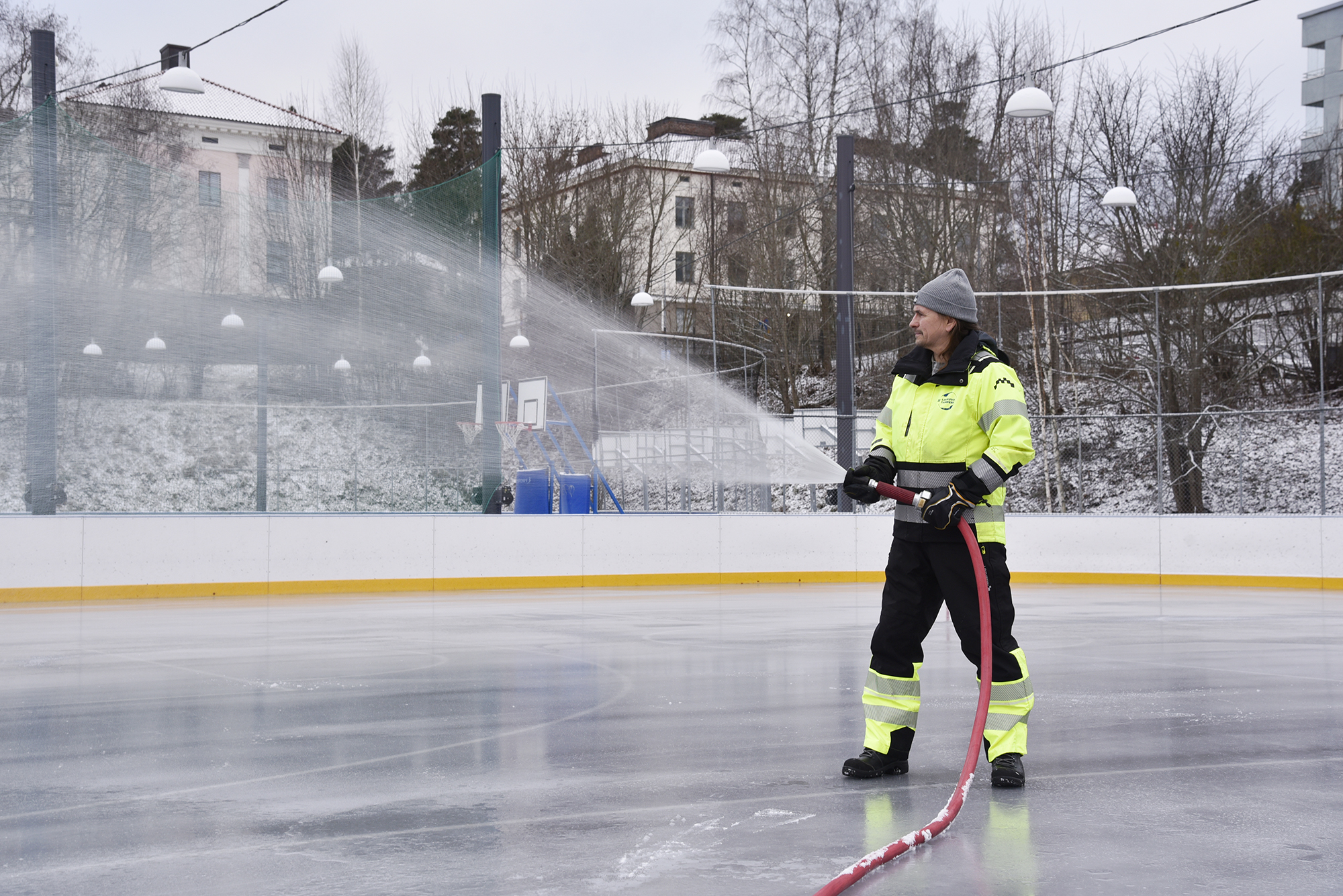
There are four artificial ice rinks in Tampere: on Koulukatu, in Sorsapuisto, in Lielahti and in Ahvenisjärvi. The freezing of these rinks began earlier in November, when the average daily temperature was around zero and there was no snow. Typically, this happens in mid-November, and this season followed the pattern of previous years.
The remaining skating rinks are natural ice rinks, which are even more dependent on the weather and usually last from Christmas to January. Without continuous freezing temperatures, the ice does not form or remain on these rinks.
The rinks are maintained by both Tampere City Sports Services and Tampereen Infra staff
Jussi Pesonen, work manager at Tampereen Infra, says that the city has both natural ice rinks with boards and open ice rinks. The rinks with boards are maintained more actively.
– The rinks are mainly maintained by an employee five days a week. Depending on the conditions, the ice is frozen daily, and if the rink is empty, it is frozen twice a day if possible. This is rare, of course, as the rinks are in very active use by schools and daycare centers during the day, Pesonen says.
Open rinks are frozen three times a week with optimal equipment, or more if necessary. Employees visit the rinks in each area to freeze them. Some of the rinks are frozen using a tanker truck, while others have a well or water tap nearby. For the time being, however, all rinks are frozen using tap water. Lake water is dirtier, and dark colors in the ice, such as tree leaves, cause faster melting in sunlight.
Starting the freezing process requires daily temperatures to remain mainly below zero. One or two days of frost are not enough, or the work that has been started will melt in above-zero temperatures. Rain in particular melts ice effectively.
– In recent years, freezing has been able to begin in December, but unfortunately it can sometimes take until early January before the ice is ready for skating, says Pesonen.
Creating a proper base is important
In an optimal situation, a base is tamped down from snow onto the ice, which is then watered several times. This forms the actual ice for skating. Preparing the base takes a lot of time, as the tamped snow base is watered thoroughly. If the base is not prepared properly, the entire freezing process will fail.
During the season, the actual freezing process, which is used to repair skate marks, for example, takes about 45 minutes, depending on the rink. After that, the water still has to freeze. Freezing usually takes about 30–120 minutes, depending on the conditions.
Before freezing, the rink must also be plowed. Freezing a snowy rink creates an uneven surface that does not meet the requirements for skating ice. The ice must be clean when water is sprayed on it again to keep the surface skatable. The duration of plowing depends, of course, on the amount of snow.
– The optimal conditions for freezing are at least -5°C, dry air without snowfall, and a light wind. If the temperature is closer to zero, freezing takes a long time, while snowfall makes the ice surface rough and sticky. Wind, on the other hand, promotes freezing, Pesonen explains.
Artificial ice is initially cooled using a slab
Master Builder Pasi Lähteenmäki and Sports Facility Managers Jukka Pohjola and Perttu Koivula from Tampere City Sports Services are sitting in the locker room of Koulukatu field, Finland's most legendary and first artificial ice rink. They don't usually have time to spend in the break rooms, but now there is a moment for an interview and photos.

The freezing of artificial ice rinks begins with the cooling of the base slab. The cooling pipes under the slab should be turned on when the air temperature is no higher than +5 degrees Celsius. It takes a couple of days for the slab to cool down, after which freezing water can be sprayed onto it – provided that the average daily temperature is below freezing.
– Rain is the worst thing for freezing. Humidity also slows down ice formation. On natural ice rinks, the sand base freezes faster than artificial turf, Pohjola says.
Freezing takes at least a week, as the ice must be at least 3-4 centimeters thick and water is sprayed with a hose in thin layers to ensure the quality of the ice. More water is sprayed as soon as the old layer has frozen properly. This is first tested with a watering can. Artificial ice thickens on its own over time.
– However, it must not be too thick, so that the freezing equipment does not consume too much energy, the men point out.
The City of Tampere's Sports Services employs 35 people to maintain the ice rinks. There are plenty of users on the rinks, as Koulukatu alone is used by school groups on weekdays from 8 am to 3 pm and by other groups at other times. Koulukatu is the most typical ice hockey rink of the artificial ice rinks, while Sorsapuisto, for example, is more suitable for public skating.
– Traditions on this rink are binding, and the Winter Classic ice hockey tournament is also played here every winter, Pohjola, Koivula, and Lähteenmäki remind us.
It is worth checking the Outdoor Sports Conditions Service for up-to-date information on the ice conditions.


