
Teemu Haapakoski built thousands of euros worth of studio equipment from discarded furniture
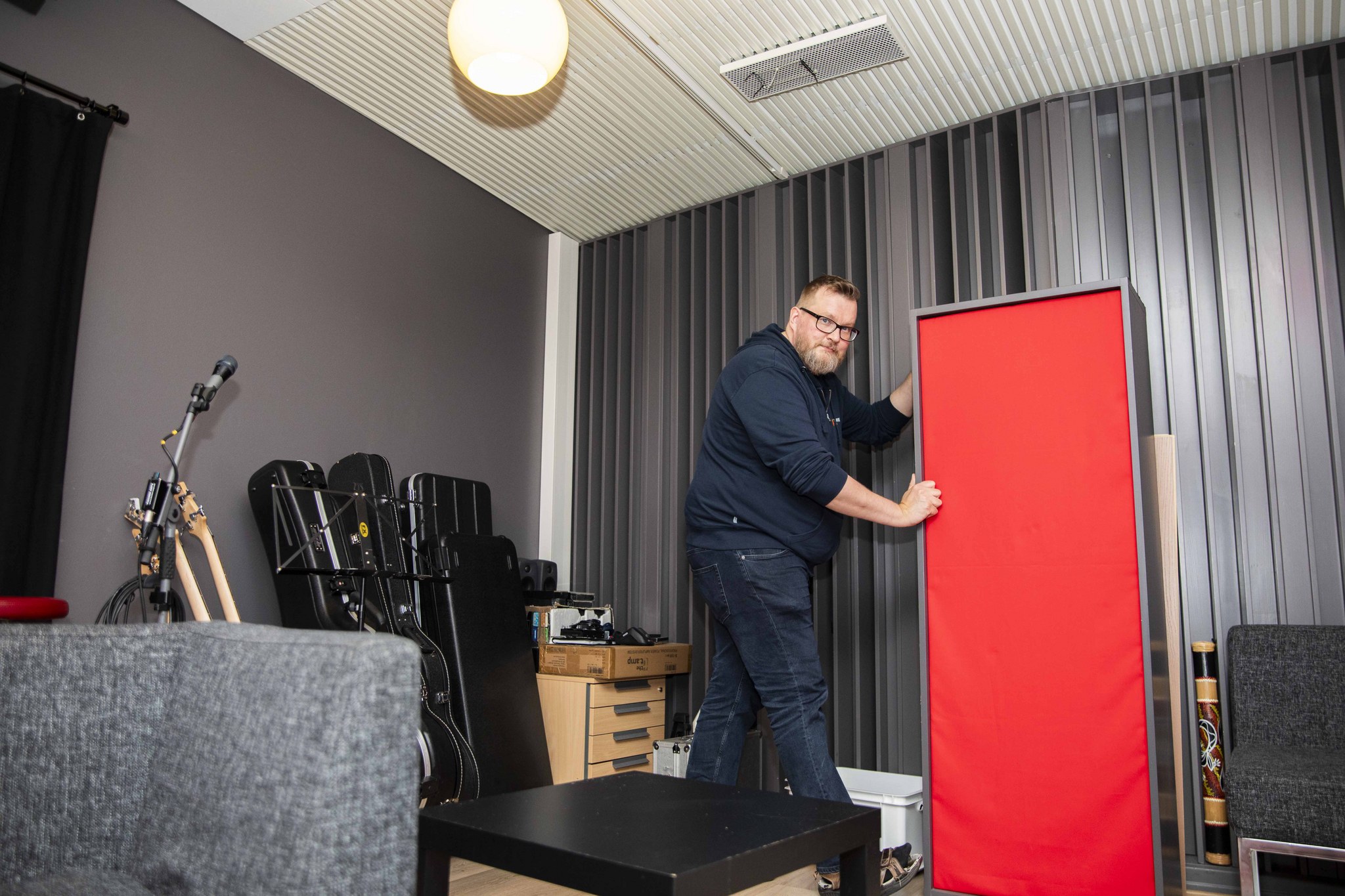
Youth worker Teemu Haapakoski takes a firm grip on a large wooden furniture he has made and moves it a little closer to the back wall of the studio in the Monitoimitalo 13. However, moving the heavy bass trap causes Haapakoski to change his grip to a tighter one.
– They didn't move easily from the garage to the studio either, jokes Teemu Haapakoski.
The youth worker, who has been working mainly in the studio for eighteen years, was awarded in the Personnel as Developers competition at the Town Hall in early June. The reason for the award was the bass traps which Haapakoski had made himself in his garage for use in the music studio.
Expensive acoustics from bookshelves
A bass trap is an acoustic product designed to eliminate low frequencies in sound. Due to surface and wall reflections, the sound coming from the speakers is distorted indoors to the listener's ears. The studio therefore uses a wide range of acoustic materials, such as carpets and furniture.
In the Monitoimitalo 13 studio, Haapakoski struggled with bass frequencies for a long time, and measurements helped him to notice a big "sound hole" in the low frequencies. New acoustic materials were needed for Monitoimitalo 13, but bass traps are not the cheapest acoustic elements.
– Bass traps, which absorb low frequencies, are the most expensive acoustic elements needed for studios. The bass traps needed for a studio would have cost over a thousand euros each and they are only in the USA.

Haapakoski is one of the av-tech correspondents at the Monitoimitalo 13. Haapakoski is interested in the behavior of sound in music, working with technology and how to get the best out of these areas. As a youngster, through playing tuba and drums, Haapakoski eventually became interested in sound and lighting technology, working as a freelancer for various sound engineering companies.
– I toured with Tiktak and Uniklubi, and worked as a DJ while studying.

Instead of buying new bass traps, Haapakoski found the drawings of the needed bass traps online. After a short investigation, Haapakoski bought the drawings for a few tens of euros and started looking for suitable materials.
– The Monitoimitalo 13 was going to the threw old stuff away and I noticed the bookshelves, which were made of sturdy chipboard. And I took them with me.
In his own time, Haapakoski built bass traps from the old bookshelves according to the drawings, and after a while the studio Monitoimitalo 13 no longer suffered from low-frequency sound holes.
– I'm not much of a tinkerer, but this project turned out well.
– I want to inspire people to reuse second-hand goods and reduce waste. You don't have to throw everything in the trash, concludes Haapakoski.


