
Aija Karttunen highlights the importance of resident participation
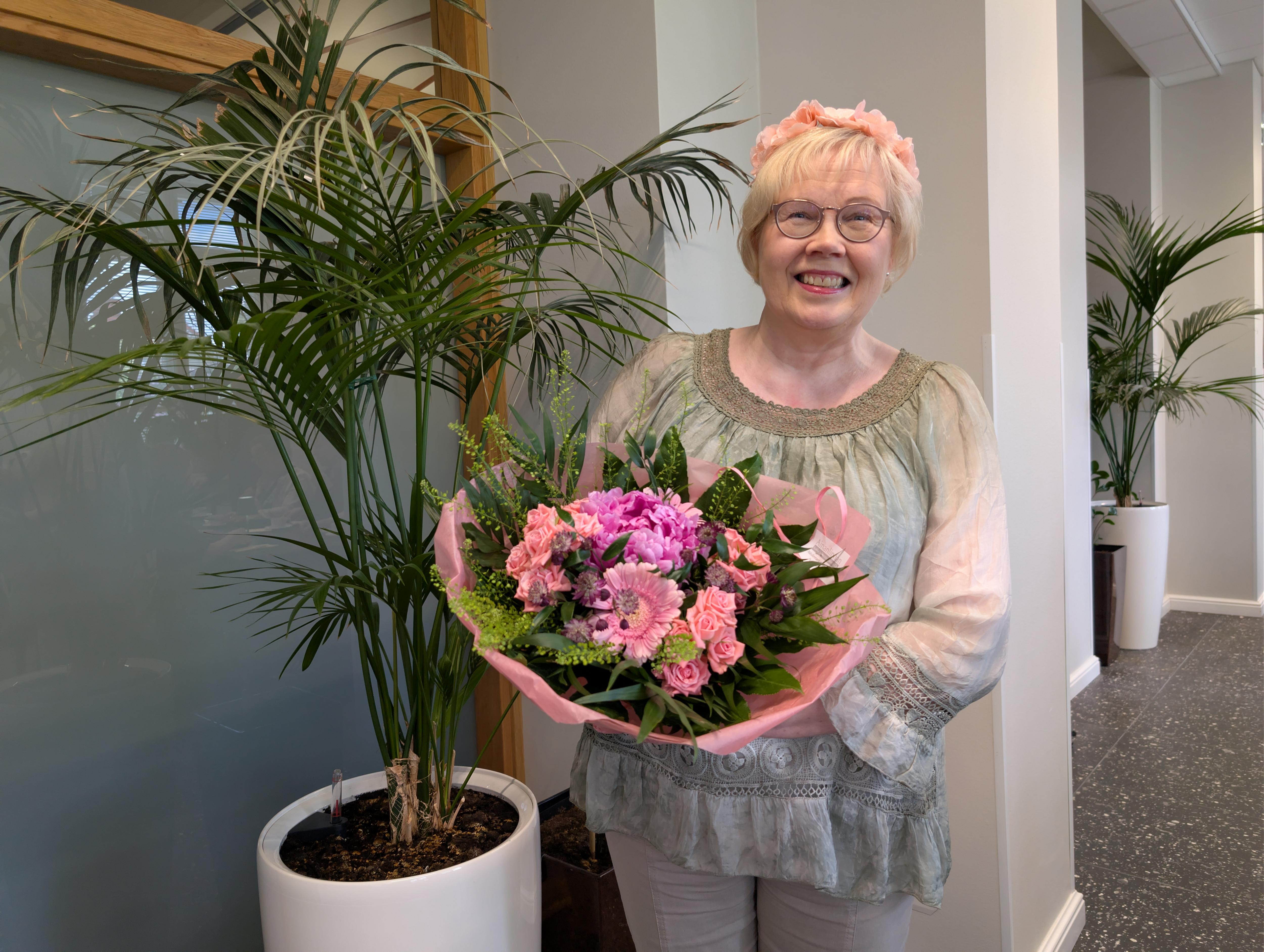
A brightly smiling woman sits at a table in the Viistokatu café. Aija Karttunen has returned from her summer holiday for a short while to the City Hall to take care of her final tasks before retiring.
Aija Karttunen has worked for the City for nearly 16 years. In her roles as an Interaction designer and Regional coordinator, she has become familiar to many Tampere residents and city employees.
Aija’s career with the City began in September 2010 in the Municipal Democracy Unit, led by Development manager Antti Leskinen. Her colleagues included Sirpa Koivu, Birgitta Tunturi, Annamaria Valanto, Eija Uurtamo and Ea Tokas.
The team developed and ran the Alue-Alvari model as one form of participation and influence. Its aim was to bring the voices and experiences of residents from different areas of Tampere into the preparation of decisions. The Alvari groups served as channels of interaction between the City and its residents, providing information about the development of local areas and enabling residents to take part in planning services.
Alue-Alvari groups operated in the south, south-east, north-east and west. Aija was responsible for the South Alvari area, which extended from Viinikka to Multisilta and from Härmälä to Muotiala.
The importance of resident participation has grown
– At the time, the Municipal Democracy Unit was still unfamiliar to many, Aija recalls.
People in Tampere understood why resident participation matters, but many decision-makers still needed convincing. In their view, the statutory channels for participation – voting in elections and public consultations, for example in planning matters – were sufficient.
– A great deal of progress has been made over the past 15 years. Today, it is taken for granted that residents’ views are heard and taken into account, Aija Karttunen says.
In the 2010s, Tampere was among the national frontrunners in municipal democracy work. The city’s Alue-Alvari model and the online Valma preparation platform attracted interest from other cities. Aija also presented them to organisations and municipalities across Finland.
A trusted figure in every situation
Aija still has many interesting tasks in mind from her time with the Alue-Alvari groups.
– Together with the Alvari groups, we created visions for the future of different areas. These were turned into a video, which 15 years ago was something quite new and unusual. The video was shown to the City Council, shared online and presented at an event organised by Kuntaliitto, the Association of Finnish Cities and Municipalities, Aija explains.
The most rewarding tasks were related to the use of the local development funding allocated to the Alue-Alvari groups. Each area was assigned €5,000, and the residents themselves decided how the funds would be used.
– The South Alvari group always wanted to set aside part of this funding for their own summer celebration. Local actors agreed among themselves who would apply for the funding each time for the jointly organised event, Aija says, describing the residents’ smooth cooperation.
The location of the event also varied from year to year. The celebration was held, for example, in Rantaperkiö, Nekala, Koivistonkylä, Järvensivu and the arboretum.
– These shared summer celebrations were important to residents. Even now, people still ask me whether these events are still organised in the southern area, Aija says.

Aija quickly became a familiar figure among residents. Originally from Liperi in North Karelia, she is an open and approachable person, and even strangers tend to open up to her quickly about their situations.
– People started contacting me about all sorts of unusual matters. For example, I once advised a family with an immigrant background on where to find information about fertility treatments, and I suggested to one real-life ‘inventor type’ who they could approach with their imaginative ideas for replacing the tram system with air transport, Aija laughs.
– It gives me great satisfaction when I can sort something out and guide people to the right authority who can help them further, she says.
Coordinating networks at a wellbeing centre
The Alue-Alvari model came to an end in 2017.
Around the same time, other reforms were also taking place. The City abandoned the purchaser–provider model, which had been in use for about a decade.
Tampere also chose not to wait for the long-prepared national social and health care reform to be completed, but instead began developing its own wellbeing centre model. The aim was to make life easier for residents by bringing together services that support health, wellbeing and everyday living within the wellbeing centres.
These changes also affected Aija Karttunen’s role. However, resident participation remained the guiding thread throughout her work.
– Each wellbeing centre had its own Regional coordinator whose task was to build cooperation between local actors, Aija Karttunen explains.
At the beginning of 2017, Aija was appointed Regional coordinator for the southern and south-eastern areas. Her workplace moved from the City Hall to Hervanta, where she had her own office in the library. However, her work remained highly mobile and involved meeting people extensively.
Aija’s work increasingly focused on leading networks. Once a month, she convened an area network meeting where city representatives, decision-makers, associations and other organisations, businesses and residents came together.
Through the network, the City shared information about ongoing preparations, while local actors and residents contributed experiential knowledge and views on matters under development.
There were area networks in five areas, led by the Regional coordinators.
– The idea behind the area networks was excellent, but the practical implementation didn’t quite succeed. The meetings were held in the evenings, which suited residents well. However, it was sometimes difficult to get city representatives to attend, Aija Karttunen recalls.

A new era began with the pandemic
At the beginning of 2020, Aija’s role expanded as she became responsible for all five area networks following colleagues’ retirements. Each network met once a month.
Operations changed abruptly in March 2020, when gatherings were restricted due to the COVID-19 pandemic.
– I remember the start of the lockdown well, as I was supposed to hold a resident event in Hervanta the following day. It ended up being cancelled, Aija Karttunen says.
– All five of the March area network meetings had to be called off.
The pandemic had a significant impact on the work of a Regional coordinator. For a couple of years, it was not possible to organise resident events where people could gather in the same place.
– It was a good time to rethink the participation model. After the pandemic, the city began organising resident events and networks of associations and other actors in a completely different way, Aija explains.
Previously, resident events had been expert-led: a speaker would introduce a topic, which was then discussed. There were also workshop-style events.
In the new format, the power structure of resident events was turned upside down. The stars of the Tampere Residents’ Evenings were the residents themselves, who could drop in at a time that suited them and explore topics that interested them at their own pace at different stands. Everyone had the opportunity to share their own views.
Music and cultural performances were also introduced as a new element. Local associations were invited to present their activities to other residents.
– The Residents’ Evenings were developed in my last team, Community and Development Services within the City’s Education and Culture Services. The ideation and planning were carried out together by the entire participation team. Regional coordinators Jarno Koskinen and Noora Karumaa in particular contributed to creating something new, Aija says.
After the pandemic, nine local actor networks also emerged, bringing together local actors, the city and the wellbeing services county to build cooperation for the benefit of the area.
– Nothing is as constant as change, Aija observes.
– The local actor networks are now also being reformed. I was still involved in preparing the changes, but the implementation will be left to others.
Heading into retirement with satisfaction
Aija Karttunen is entering retirement with a light heart. Participation in Tampere is in a good state, and residents’ views are valued.
– This has been a truly privileged vantage point in many ways. I’ve had continuous contact with political decision-makers, officials, experts and residents. I’ve been able to see how things progress and how different perspectives are brought together.
– I couldn’t have imagined a more suitable job for myself, Aija says.
During her retirement, Aija plans to revive a couple of old hobbies: yoga and salsa. As usual, she will spend the summer boating on Lake Näsijärvi with her husband Jari.
– I also want to stay in closer touch with friends I made already in my youth, who are now spread across Finland, Aija says.
– I’ve also made friends through work, as well as, of course, a large number of acquaintances. I’ll be seeing you at Tampere Residents’ Evenings and other resident events, Aija Karttunen promises.


