
Leisure-time communities bring richness to the everyday lives of working-age people
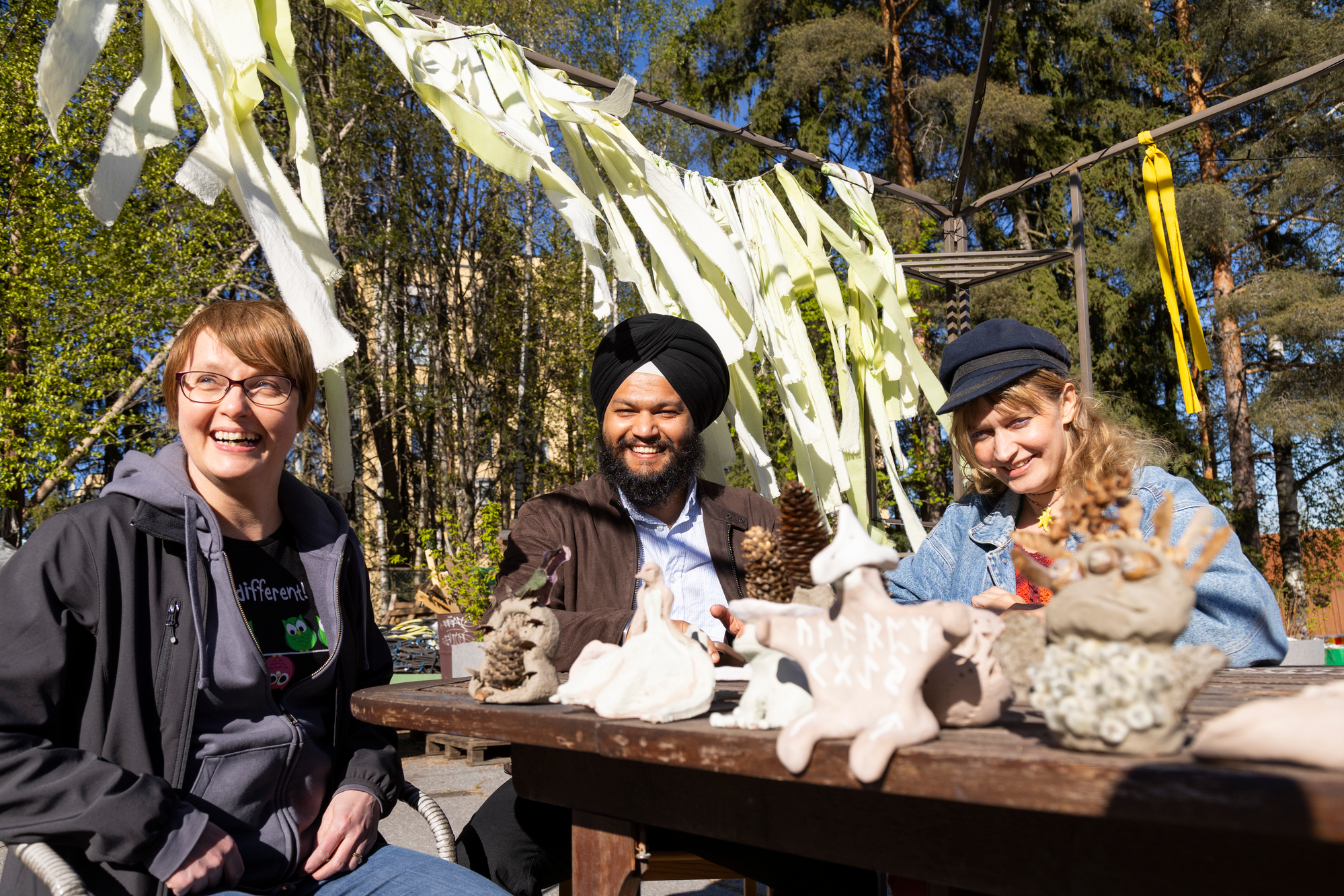
In the courtyard of the old garage, a community plant is about to bloom and the first art exhibition of the summer has just opened inside. Kaleva hall, run with city support, has become an important place for many working-age people to meet people of different ages and backgrounds.
Tarja Salminen has been involved in the gardening community from the very beginning, since summer 2024, together with her husband and now adult son. In the Salminen family, it has been important to show their offspring how to grow their own food.
– Through gardening, our whole family was able to join the group easily. Here you can chat about gardening or simply keep busy on your own and still feel part of something, Salminen says.
The City of Tampere’s wellbeing plan has identified key challenges to the wellbeing of working-age people as feelings of loneliness, mental health issues, a lack of inclusion and increasing individualism. The City aims to support wellbeing by offering opportunities for participation and leisure activities.
In a city built on doing things, it is natural to strengthen community through shared activities. Anyone can propose new activities at Kaleva Hall by contacting the Jälleenrakentajat cooperative, which coordinates the centre’s operations.
Like a small village community
Ronja Ilander first came to Kaleva Hall through people she knew from the LABRA collective, which launched the venue’s cultural activities. She has also prepared food for events at the hall during the summer of 2025.
– This really feels like a small village community, Ilander says. – It’s a very open and genuinely safe space, with all sorts of different people. You can sing karaoke here without alcohol. It’s a non-commercial place where you can simply be yourself as a person.
Amandeep Singh agrees with Ronja. He and his partner have been involved in the community garden for their second summer now.
– Here, you can live in the moment. You don’t worry about anything, and everyday concerns fade away. It’s also a healing place. Working with your hands, watching things grow and seeing the results also helps you grow internally, Singh reflects.
“There should be places like this in every neighbourhood.”
Singh and his partner have also brought their friends and their children to Kaleva Hall’s summer events, where they have enjoyed the art festivals.
After the gardening season, some members of the community garden were sorry to see the Friday gatherings come to an end, and came up with a winter alternative: Kaleva Club, a meeting place open to all adults.
– We’ve been going to Kaleva Club to play darts and spend time with people, Singh says.
– My son has been to the Club to play Carcassonne, and my husband and I have been there to sing karaoke and play darts. You can also simply be there without taking part in anything if you don’t feel like it, Salminen adds.
Ilander was invited to run a mosaic workshop at the Club, and was inspired to set up her own Anarchist Ceramics Club at Kaleva Hall.
– I work as a ceramic artisan, but work is still work, even in creative fields. I’d been longing for something just like this as a counterbalance to my job – a club where I don’t have to think about money, but can make things freely and creatively, even a bit wildly, together with others.

All activity is beneficial
For many people in Tampere, unemployment is currently the single most significant factor affecting wellbeing. It impacts income and health, creates feelings of exclusion and increases the risk of social marginalisation.
Olesia Klesman, a client advisor in employment services at International House Tampere, says that job searching is distressing for all unemployed people. – When, despite repeated attempts, you cannot find work, it is discouraging for everyone, Klesman notes.
Around 12 per cent of Tampere residents have roots abroad. For them in particular, difficulty accessing the labour market is often the biggest factor affecting wellbeing.
According to Klesman, employers are still unfortunately cautious and have a limited understanding of the benefits that someone with an international background can bring to the workplace. There are various preconceptions, such as concerns about language barriers and differences in working culture. Education does not always help either, if employers are unsure about foreign qualifications.
– Internationality generally enriches the workplace and brings skills that may not have been there before. For people who have moved here, finding a job is also a great source of pride, as it requires so much effort, Klesman explains.
In Tampere, tailored support is used to improve employment prospects. Each jobseeker’s skills are assessed, and applicants can take part in various training programmes that support employment. Time spent without work can be used for studying, attending recruitment events, practising job search skills and investing in personal wellbeing.
– Networking plays a key role in finding employment today. It is not a good idea to stay at home – you need to stay active. Everything you do and take part in also helps you build networks, Klesman says.

A bit like being abroad
Salminen, Singh and Ilander are all currently in employment and also have supportive workplace communities. Even so, the community at Kaleva Hall is an important source of wellbeing for them. A workplace can often be a bubble of like-minded people, whereas at the hall you can forget everyday routines and chat with people from different backgrounds.
– It’s a bit like being abroad, Singh says. – When you come to Kaleva Hall, people greet you and smile, even if you don’t know anyone. There’s a lot of loneliness these days. Every neighbourhood should have places like this.
– That’s right. I live in western Tampere, so it’s a bit of a journey to get here, Ilander says. – But I’ve found my community here, and I’m happy to make the trip.
What is the wellbeing plan?
The City of Tampere monitors the wellbeing of its residents using a variety of indicators. These have helped to identify the strengths of different age groups, as well as the challenges that undermine well-being.
The City of Tampere’s wellbeing plan brings together age group–specific objectives and examples of actions to promote the wellbeing of Tampere residents during the years 2026–2029. The city promotes wellbeing in cooperation with, among others, the Wellbeing Services County of Pirkanmaa and civil society organisations.
Read more: Wellbeing plan


