
In early childhood education and care, children learn through play and creativity
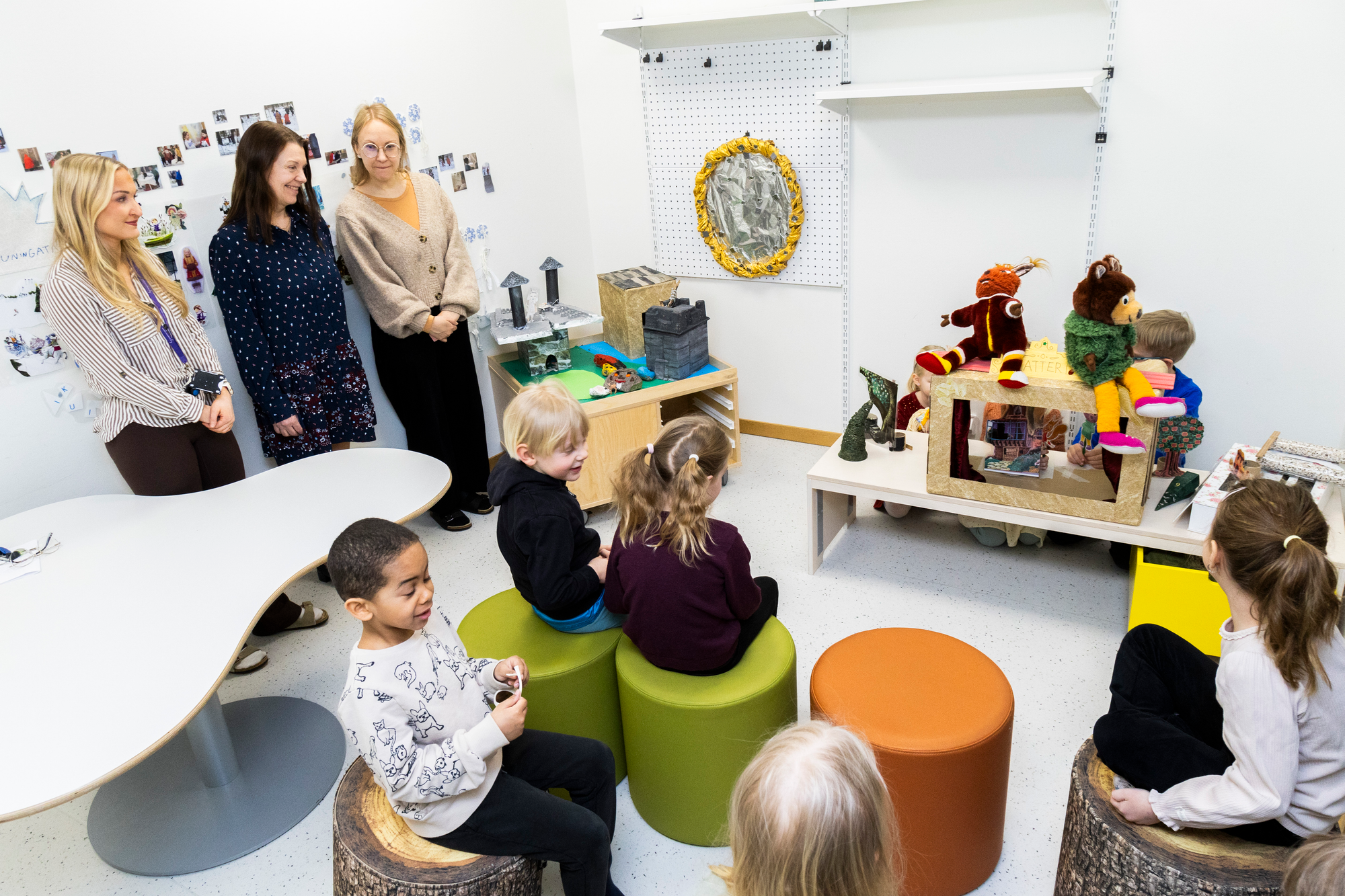
– The best thing about the mysteries is that everyone in our group is involved in them and that “Töröhattu” has appeared only to us, says Mustametsä pre-primary pupil Hertta Tuomivaara.
The mysterious Töröhattu is part of pre-primary teacher Sonja Laitila’s pedagogy. As a doctoral researcher at Tampere University, Laitila studies children’s engagement in language learning through play-based pedagogy. By solving the problems set out in the letters sent by Töröhattu, the children in the "Tunturipöllöt" pre-primary group learn language skills, problem-solving and collaboration.
The City of Tampere’s new Paths of Education and Learning 2025–2035 programme aims to ensure that every child and young person has the opportunity to grow and develop as themselves, fulfil their potential and take part in the community. According to the City’s Director of Early Childhood Education, Elli Rasimus, the goal is a shared vision stretching from toddlerhood to the threshold of adulthood.
– Learning begins in early childhood education and care. We must look after the whole age group and support every individual. To achieve this, children need the feeling of being seen and of being able to grow in an equal and safe atmosphere, says Rasimus.
Every child should be seen as an individual
At Mustametsä Daycare Centre and in pre-primary education, recognising children as individuals is part of everyday practice. However, it requires staff to actively reflect on their own ways of working.
If daycare centre staff do not regularly pause to reflect on the kind of relationship they have with each child and on how each child is being noticed, a quieter, more reserved child may receive less attention in the rush of everyday life.

According to Leena Laine, head of the Mustametsä early childhood education and care unit, major changes have taken place in early childhood education and care over the past couple of decades. One of them concerns children’s access to individual support.
– We have extremely skilled staff here. Our employees observe the children, get to know them and are therefore able to identify their different ways of learning, as well as their individual strengths and support needs. Every child is seen as an individual, but also as a member of the group. A child needs both to belong to a community and to be valued as themselves, says Laine.
Sonja Laitila says that, for example, a child may seem not to be following a group situation at all, but afterwards may be able to say that the best part of the moment was working out the syllables.
– A child must be taken into account as a whole person. Some communicate physically that they are enjoying themselves, while others express it verbally. For a child to be fully seen, cooperation among staff and with guardians is extremely important, says Laitila.
Problem-solving and watching out for Töröhattu
The Tunturipöllöt group has become fully immersed in the world of Töröhattu, which they have created together. Laitila says the enthusiasm usually begins with a few children and then spreads to the rest of the group.
– Any group will get carried away by it, but this group has been especially quick to get excited.
According to Alvar Virtanen, almost everything about Töröhattu and the messages it sends has been fun, especially Töröhattu itself.
– It somehow seems like such a nice character, and it sends us mysteries. We send it post and it often replies. The best part was when we got a little bowl and written instructions about what should go into the magic potion. We left the magic potion at the Owl Tree, and then it disappeared, says Virtanen.
Elsa Haaranen and Hertta Tuomivaara enjoy problem-solving just as much as watching out for Töröhattu in the forest:
– It has been fun to make the magic potion and find the owl again when we solved the mysteries. They were fun because we had to write the initial letters and then found out where the key was.
Early childhood education and care lays the foundations for learning
– In early childhood education and care, what really matters most is supporting a child’s sense of self-efficacy. When a child is learning something new and does not succeed at first, our task is to say: you can do it, and I will help you. We reward perseverance and effort, not outcomes, says Laitila.
According to the Mustametsä staff, supporting self-efficacy and learning to learn works best when creativity, play, joy and humour are part of it. The foundations for literacy and numeracy are built from an early age as part of everyday life at the daycare centre, as well as in play and on forest trips.
Although many of the themes included in the Paths of Education and Learning 2025–2035 programme are already part of early childhood education and care under legislation, Laine and Laitila welcome the new shared direction. It sharpens the common goal still further.
– Tampere has invested in early childhood education and care and pre-primary education for a long time. The resources are good, and they support educational work. Here, we lay the foundations for children’s learning skills and their desire to learn new things. One would hope that the joy of learning continues throughout a child’s learning path, says Laine.
Something that seems frightening may in fact be shy and quite kind
In addition to solving puzzles, Laitila’s pre-primary pupils especially enjoy putting on puppet theatre. At first, the children created performances under the guidance of Laitila and the group’s childminder Jaana Näppilä, but now they are already producing them entirely independently.
Isla Kopponen, Elsa Haaranen and Alvar Virtanen had already prepared a new play today before Laitila arrived at work. One of the children also creates sound effects and music for the performances using instruments.
The highlight of the year for the Tunturipöllöt group has been making their own film. The story of the Snow Queen also sparked good discussions. The children wondered whether the Snow Queen is really so mean and what might have happened to her. The children reflect on Töröhattu in much the same way.
– Töröhattu wears black clothes, is kind but a little timid, and sends mysteries. But people who are timid are usually also quite kind, say Elsa Haaranen and Hertta Tuomivaara.

Paths of Education and Learning 2025–2035 programme
“The City of Tampere’s new Paths of Education and Learning 2025–2035 programme aims to make Tampere Finland’s leading education city, where every learner is encountered as an individual and as a member of the community. Tampere wants every child and young person to have the opportunity to grow and develop as themselves, fulfil their potential and take part in the community.
The programme’s priorities emphasise a safe and caring learning environment, mental health support and the prevention of bullying. Literacy and multilingualism are strengthened throughout the education path, and Finnish-language learning for children whose first language is not Finnish is supported from early childhood education and care to higher education. Digitalisation and artificial intelligence are used to support individual guidance while also preserving unhurried encounters and strengthening learners’ basic skills.”


