
Erasmus+ programme offers high school students a window on Europe
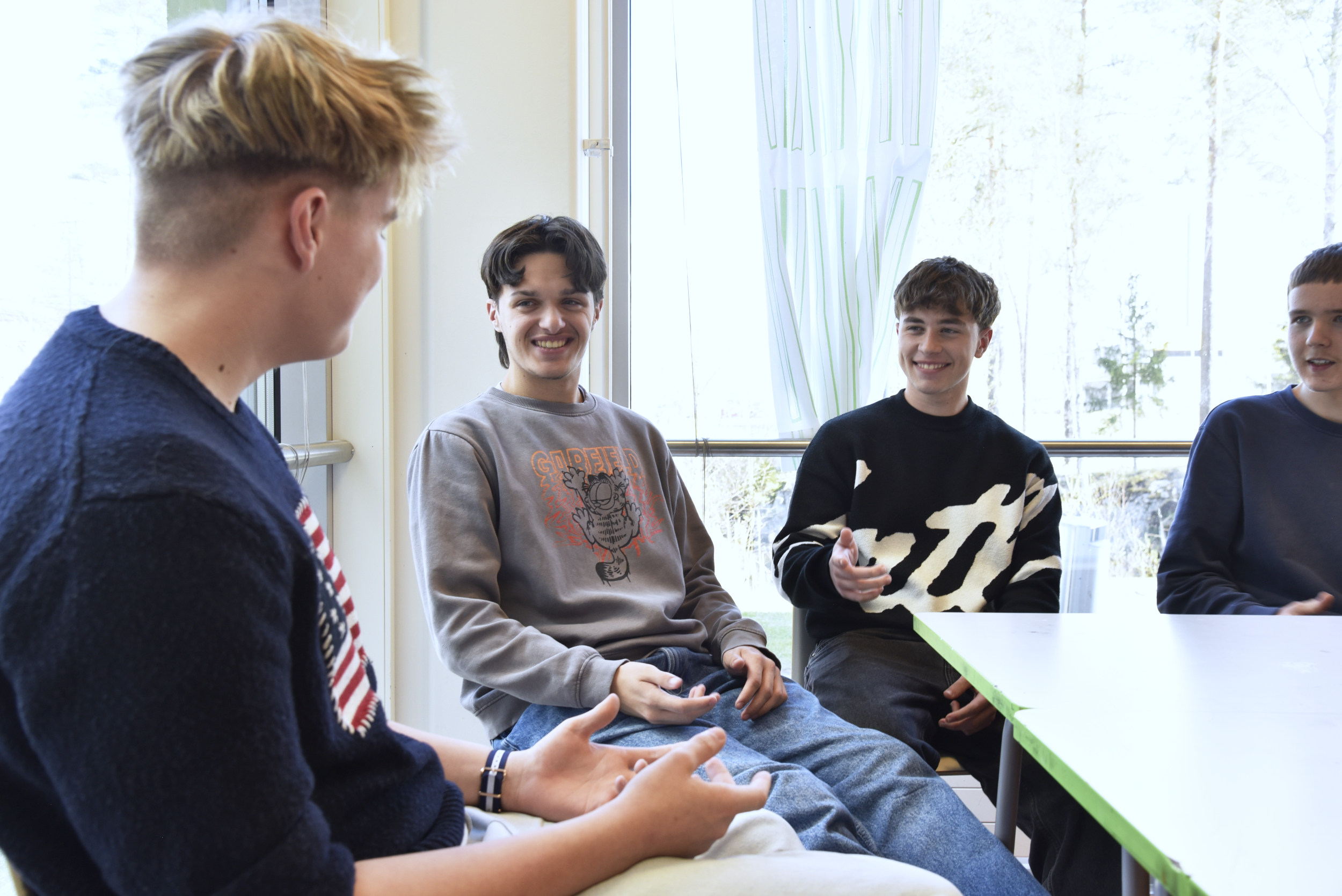
Five Finnish and two Spanish students sit in the visual arts class at the Tampere High School of Technology. Ignazio Vasquez and Enrique Dominguez, from Seville, have been in Finland for two weeks, touring the country as far as Lapland. Their trip was organised by their own school and they had to pass a video interview before being accepted. The duo had little prior knowledge of the country, but the experience has been positive.
– It's very different here from back home. There are more trees and it's cooler. Tampere, though, has architecture reminiscent of small Spanish towns. In Finland, there are more computers at school and far fewer exams, which makes studying less stressful, they say.
Stretching in class brought reproach
The differences in study cultures are also highlighted by Finnish students who have been on exchange abroad. Eerik Kautto, who visited Heiligenhaus in Germany's Ruhr district, liked the town's architecture, but describes the German school system as more hierarchical than Finland's. Phones were not allowed in school at all.
Jimi Hevonoja, who visited Seville, also praised the city's old architecture, noting that discipline and hierarchy were stricter in Spain than in Finland.
– I was reprimanded by my teacher for stretching on the desk in the middle of class. The ban on mobile phones was absolute and if you broke it, you could get a mark, which would affect your further studies. There was only one break and you couldn't leave the school grounds, she says.

They both think it was important to get to know a new culture, as do Voitto Liljeroos, who spent two weeks in Seville, and Kiia Karppinen and Aaro Yläkangas, who spent an exchange in Germany.
– Seville was lively and vibrant. It surprised me that Spanish food is not spicy, Liljeroos laughs.
Karppinen and Yläkangas were surprised to learn that German high schools have children as young as ten. The reason is that the choice between vocational and general education is already made in primary school, just as it was in Finland in the early 1970s.
Everyone says that after the trip they will look at the Finnish education system with new eyes. Everyone's language skills also improved, even if communication was in English.
The programme is also suitable for people on low incomes
Mari Rintanen, vice principal, has herself been on an Erasmus+ exchange in Germany. There she observed teaching and exchanged ideas on school systems and practices with local teachers.
– We have been involved in the programme for a few years. Our accreditation expires next year, but hopefully we will be able to continue, she says.

Strict quality standards are required for schools accepted into the Erasmus+ programme. The annual grant awarded to the school by the programme will cover students' travel and accommodation costs, with the exception of a small co-payment. Students usually stay in family accommodation, which helps them to get to know a new culture. The exchange takes place either individually or in a group and usually lasts a week or two.
– One of the aims of the programme is to enable students who would otherwise not have the financial means to go on exchange. This is also one of our selection criteria, says Rintanen.
Tampere High School of Technology has partner schools in four countries, Austria and Slovakia, in addition to Germany and Spain. The principal and teachers have visited the host schools before sending students to them.
Rintanen is happy to travel with the students when schedules permit, and there is little need to protect 17-year-olds. There have been no excesses, and the students have behaved well abroad.
– I've also noticed that even shy students are encouraged to chat with the local young people on the second day and become part of a group, says Rintanen with a smile.


