
Tampere is placing even greater emphasis on swimming instruction
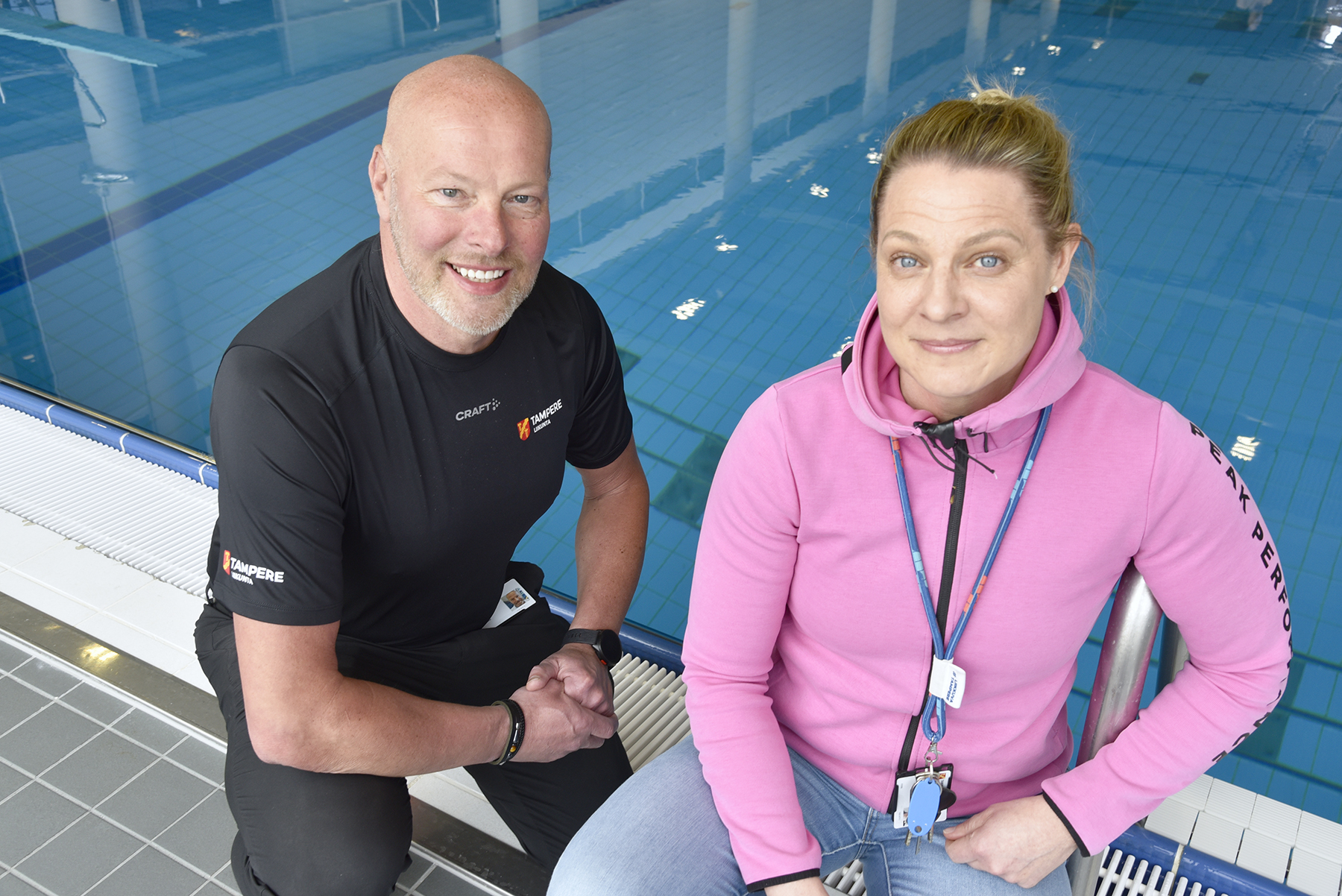
Tampere Swimming Centre is bustling in the middle of the day. Head of Sports Hanna Murotie and Lead Sports Instructor Tommi Liimatta are in familiar surroundings here, as the duo are the main people responsible for developing recreational swimming education in the city's sports services.
- Last summer's drowning accidents prompted the city to invest even more in swimming lessons. However, the situation in Tampere was already quite good and there is a long tradition of swimming lessons here, says Murotie.
The range of measures is wide. Swimming schools are being expanded, the concept is being reformed, all sports instructors have been trained as special swimming instructors, special attention is being paid to teaching children and young people with an immigrant background, as well as women and girls.
Swimming schools in halls, on beaches and in the Outdoor Swimming Pool
Swimming schools are, of course, central to the development of swimming skills and so there are many ways of investing in them. The number of swimming schools offered is being increased in swimming pools, Outdoor Swimming Pool and beach swimming schools. The latter will be concentrated in Hervanta, Kaukajärvi and Tesoma, which have the largest immigrant populations.
- For them, swimming in open water can be culturally easier. Young people are best reached at the Outdoor Swimming Pool, as they are not so interested in indoor swimming, Liimatta laughs.
Targeted swimming lessons for immigrants are organised in cooperation with Pirha and International House Tampere. Three events will also be organised for them in May, presenting Finnish swimming pool culture in seven languages. Pre-school children and primary school children in grades 1-4 will receive 45 minutes of lessons per week.
The swimming school concept has been revamped, including the addition of one-off family swims and baby swims where, for the price of a swimming pool ticket, families can come and swim at weekends and get tips on learning to swim on their own in Hervanta or Pyynikki, even if it's just for one session. This has been particularly popular with parents without swimming skills. It is important that parents, regardless of their own swimming ability, are aware of their offspring's skill level.
- We also offer free swimming for under-18s in May and September in the Outdoor Swimming Pool and free beach swimming lessons in the summer. We also try to attract adults without swimming skills, say Murotie and Liimatta.
Registration for the summer swimming schools organised by the city starts on Monday 18 May at 9 am. But don't worry if the groups fill up: there are three swimming schools a year, so you can still join later.
Murotie and Liimatta point out that the swimming clubs in Tampere also offer a wide range of recreational activities for all ages and stress that the clubs' activities are an important part of the overall teaching of swimming in Tampere.
So there is plenty of teaching available and the city staff are highly motivated, but the bottleneck is the lack of facilities. The current one million visitors a year is reaching its limits, so a new swimming pool or two would be in order.
Only half can swim properly
The City of Tampere's basic education department also stresses that the city's situation is good, but there is room for improvement. The legal objective is to teach children and young people to swim during their basic education and efforts are being made to improve this.
- Swimming pool visits are being increased, a system for monitoring swimming skills has been developed, more sports instructors have been hired and a school assistant has been assigned to all swimming pools. We work closely with the sports services, says Kristiina Järvelä, lead specialist in basic education, and Annika Urvikko, pedagogical specialist in educational services, herself a trained swimming instructor.
School children's swimming skills have been declining across the country and only just over half of sixth-graders can swim the Nordic definition of 200 metres, including 50 metres of backstroke. So poor swimming skills are not just a problem for migrant children. The situation is worst in places where there is no swimming pool.
- In Tampere, swimming pools are easily accessible on foot or by public transport, Järvelä and Urvikko say.
Tampere's basic education system has received €249 000 in state aid for the "Permission to swim" development project, which has helped it to hire more staff and increase the number of swimming pool sessions. A coordinator will start in June.

The problems of swimming instruction have also been identified
- Swimming lessons can hardly be increased any more and are helplessly too few, six a year for third graders and younger and at least four a year for older children. These are not a time to learn swimming skills and if a pupil is sick in his or her own class, for example, the lesson is missed altogether. Young pupils also have short days to fit lessons in, specialists say. Support classes and gender-specific swimming shifts have been organised to help.
No one dares to go to the water any more
According to Järvelä and Urvikko, learning to swim is no longer as natural a part of education as it used to be. Parents are afraid to go to the water with their children, for safety's sake, and people no longer really know how to be at the beach or at swimming pools. According to Järvelä, it is more a question of a more general erosion of the relationship with nature.
- It is perhaps not always understood that being in nature and also being near water is good for everyone. You can get a child used to water by letting him dip his toes in the lake. Cooperation with parents and communication with homes is therefore very important.
The project funding has helped to increase the number of staff, but the continuation of their work after this year depends on municipal decisions. However, sustainable models have now also been established which do not require any further investment.
- In any case, we would have improved our activities and we intend to maintain a higher level of quality in the future. Every year, new swimmers join, Järvelä and Urvikko point out.


