
Tredu provides training in home-like conditions – also virtually
A fluffy cat is lying on the couch of a small living room, and there is an old family photo on the wall. In the bedroom someone is lying in bed, and a robot that looks ready to serve stands by the door – just a moment, did you say robot?
The small 'apartment' near Tredu's Santalahdentie campus does not look quite like an ordinary home. The tables and worktops are full of technical devices, and ceiling-mounted rails with a harness hanging off them leads from the bedroom to the bathroom. The cat is also a robot, and the resident lying in the bed is a training manikin.
We are in the training room for Tredu's practical nursing students, and the devices on display represent the latest available technology – and this is not all by far.
Technology helps practical nurses in their work
Lecturer Inga Pöntiö proudly gives us a tour of the room. She explains that this is the only simulation room resembling a home in Finland. For instance, teachers can observe students' home care practice from the adjoining classroom.
– We originally practised working with older people here, but nowadays students are also trained to deal with other types of persons living in supported housing, she says.
The rails and harness in the ceiling are used to practise such tasks as transferring a person with disabilities from the bed into the bathroom.
The students do not need to just practise with manikins. Actual older people visit the facilities to take on the role of elderly persons with a variety of ailments, and apparently they play they parts with gusto.
– But the students tend to be nervous, Pöntiö laughs.
The technology on display is actually used to support older people living at home. They facilitate practical nurses' work, allowing them to spare time for socialising or other activities with the client.
A medication robot automatically calculates and doses medicines and also works during power outages, whereas a talking freezer tells you which food portion can be found in each compartment, and the oven lets you know that the food needs to be heated up and cooks it just right. Using a blood pressure monitor connected to a tablet, a nurse on the screen can guide the client in using the monitor, and the reading is sent directly to the nursing staff.
– We also use sensors to monitor the client's activity, such as getting out of bed, having meals and so on. This allows us to keep an eye on the client’s condition.
Virtual reality headsets for 3D model training
However, the culmination and greatest educational insight of the training room lies elsewhere. Santtu the robot, who introduces itself as an assistant teacher, and the meowing and purring robot cat are just a first taste.

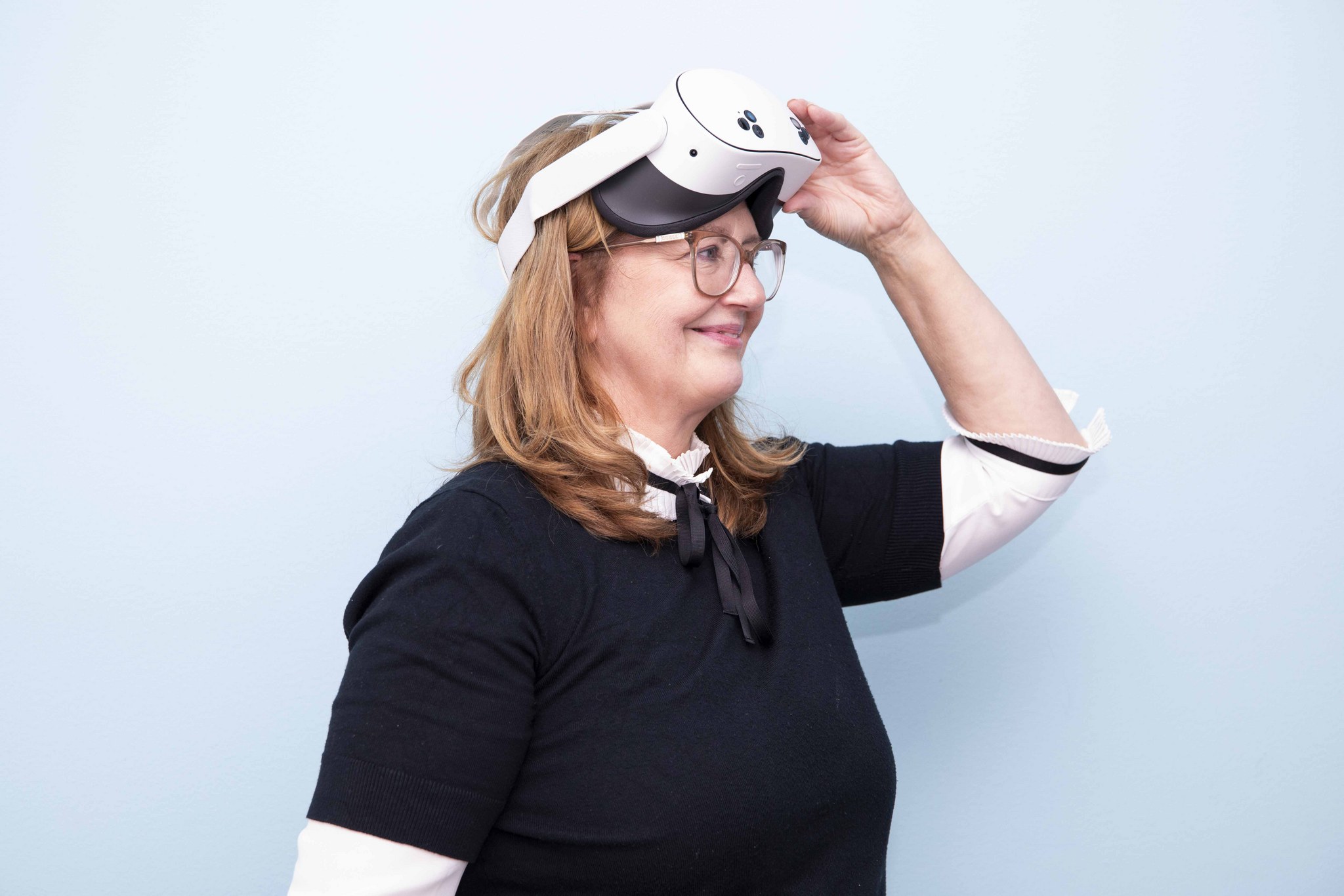
Tredu's software design students have turned the entire space into a 3D model, and students can wear virtual reality (VR) headsets to practise working in this virtual space. Before this, technical drawing students had measured the training room to the nearest millimetre for modelling purposes.
– The VR headsets help to create highly realistic situations. Wearing the headset, the student can even prepare food virtually in the client’s kitchen and see the smoke when frying something, Pöntiö smiles.
Cooperation between students in different fields naturally benefits everyone. Social and health care students gained a unique learning environment, while ICT students got a sense of how an order placed by a client should be carried out. Pöntiö hopes that this cooperation will expand further.
– We have a shared booking system of Tredu campuses for reserving well-being technology teaching equipment. My dream is that in the future, logistics students could transport the devices between campuses.
The Smart Home technology has mainly been donated by companies for testing and trialling, and it has remained in use. Costs are incurred from the license fees of certain devices, SIM card fees, and upgrades. The Smart Home concept and development of the virtual learning environment were supported with ICT funding from the City of Tampere.
– Smart technology is one of Tredu’s focus areas, and developing it is also one of the City's strategic priorities, Pöntiö points out.
It all started from a smart dollhouse
The learning space also serves as a showroom which professionals of different fields visit to familiarise themselves with the devices and activities. For example, informal carers can get to know technologies that they could use to help the person they care for. Tredu is happy to share the information and experiences gained for the use of others, too.
Pöntiö goes on to introduce us to an invention that was there before the virtual space and is still in use today: a smart dollhouse. It is a real dollhouse that allows students to think about what kind of assistive devices they would place in which room in the client’s home.
– Students are always surprised at first and ask if they, adults, have to play with a dollhouse. After a few moments, they are already excitedly planning which technologies to support living at home could be placed in which room. Students like action-based learning, and they also constantly come up with good ideas, Pöntiö praises.


